Home
Painted Baseballs
Hand Painted Bats
Platinum Series
Gold Series
World Series
Silver Series
Your Kid
Home Plates
New Arrivals
Available
CLEMENTE
Collectors
Learn To Draw
Painted Footballs
Prices
Payment Options
Display Cases
Personalized Ball
Baseball Articles
Drop Shipping
Baseball Swing
Free Newsletter
Baseball Blog
Baseball Shirts
Photos
Investment
Baseball Legends
Authenticity
How It Started
Get To Know Me
Sports Links
FAQ
Survey
Contact
Order By Mail
Order Today
Ashburn/Kalas

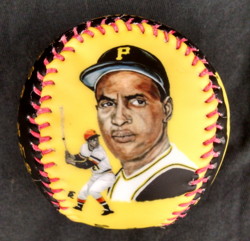
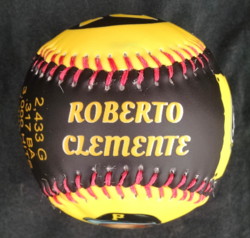
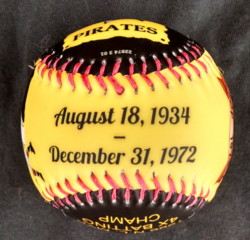
Roberto Clemente

Watch a short video tribute to Roberto Clemente

January 1, 1973. I was seventeen years old. It was New Year's Day morning and I was hanging my newest poster of Roberto Clemente on my bedroom wall.

My older sister came into my room to break the news to me. Roberto had been killed in a plane crash the night before.

Roberto Clemente was my childhood baseball hero. He died doing the one thing he did even better than playing the game. Helping others.

I was very young the first time I saw Roberto play. My Dad took me to Connie Mack Stadium in Philadelphia to see the Phillies Play. They were playing the Pittsburgh Pirates that day. I don't remember much about that game, except that the Pirates had one guy that just seemed different from everybody else. It was Roberto Clemente.

From that day on I was a Pirate fan and a Roberto Clemente fan.

Roberto played eighteen seasons with the Pirates. Back then, there was no free agency. Our favorite player played his entire career with our favorite team. Unless, they traded him. And the Pirates sure were not going to trade Roberto.

The "Great One" as they called him in Pittsburgh, began his career with the Dodgers who were still in Brooklyn. The Dodgers ran a try out camp in Puerto Rico where Roberto lived.

After signing Roberto, the Dodgers assigned him to their triple A team in Monteal, Canada.

Back then, the rule was that if a Major League club signed a player for more than $4,000, they had to keep that player on the Major League roster for at least one year. If they didn't, any other club could draft that player. The Dodgers had signed Roberto for $10,000. They knew that they risked losing him, but they kept him in Monteal anyway.

The New York Giants had also been interested in Clemente. The rumor was that the Dodgers signed Roberto, to keep him away from the Giants. The thought of Clemente and Wille Mays in the same outfield was too much for the Dodgers.

Soon, Major League scouts were showing up for Monteal games to see Roberto Clemente play. In an effort to hide Roberto from the scouts, Monteal manager Max Macon benched Roberto. But it didn't matter.

Pirates' scout Howie Haak liked what little he saw of Roberto. Branch Rickey, who was the Pirates' general manager at the time, said,"he's better than anyone we have in Pittsburgh right now. We are going to finish last and we are going to draft him".

Rickey kept his word. On November 22, 1954, the Pirates drafted Roberto Clemente away from the Dodgers. It was possibly the greatest "steal" in baseball history.

Roberto hit .255 during his rookie season. But for the next 12 years, he batted over .300. In fact he had a higher batting average during the 1960's than both Willie Mays and Hank Aaron. And his defense and spectacular throwing arm became almost legendary.

He helped the Pirates win the World Championship in 1960, hitting .314 and driving in 94 runs. Roberto hit safely in all seven World Series games in 1960.

But it was his performance during the 1971 World Series that got Roberto national recognition.

During that 1971 World Series he again hit safely in all seven games, finishing the series with a .414 average. And he did it against a Baltimore Oriloles team that featured four 20 game winners.

Roberto hit two home runs and a triple and led the Bucs to the championship, winning the series MVP award. One writer called Clemente's performance a "Tour De Force".

During the 1972 season, Roberto was closing in on 3,000 hits. Injuries slowed him for most of the season. He played in only 102 games in 1972. On the next to last day, he had 2,999 hits.

The Pirates were playing the New York Mets. The night before, Roberto almost got number 3,000 against Tom Seaver. He hit a chopper to Seaver's left. Second baseman Ken Boswell tried to field the ball but could not come up with it. The umpires stopped the game and got the ball and gave it to Roberto. They assumed it was hit number 3,000. But the official scorer did not agree. He ruled it an error on Boswell.

His last time at bat, Clemente hit a line drive down the right field line but Rusty Staub made a great catch.

Now it would be Jon Matlack on the mound for the Mets. In his second at bat of the game, Clemente lined a one hop double off the left field fence for hit number 3,000.

That hit would be his last regular season hit.

The Pirates went on to lose the National League Championship Series to the Cincinnati Reds.

In an interview near the end of the season, Roberto said that he didn't know if he would be back next year. On December 23, 1972, a massive earthquake hit the city of Managua, Nicaragua. Roberto was in charge of the relief effort in Puerto Rico.

After hearing rumors that the supplies were being sold to the people, Clemente decided to go there himself. He boarded the DC-7 that was grossly over loaded. The flight was postponed several times because of engine problems. But Roberto was determined to go. The plane took off and crashed into the ocean seconds later.

Roberto Clemente was gone. Several days later, part of the plane and the pilot's body were found, but Clemente's body was never found.

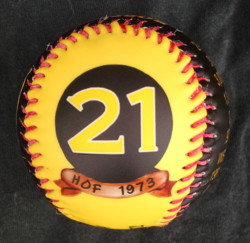
On March 20, 1973, The Baseball Writer's Association Of America held a special election and waived the five year waiting period for eligibility into the Hall of Fame. Roberto was only the second player ever to have the waiting period waived. Lou Gehrig was the other.

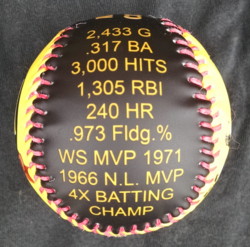
Roberto Clemente, my hero, ended his career with 3,000 hits and a .317 lifetime batting average. He won four National League Batting Titles and the MVP Award in 1966.

He collected twelve Gold Gloves and the World Series MVP in 1971.

He played in eighteen All Star Games.

At the time of his death, Roberto had played in more games, went to bat more often, drove in more runs and hit for more total bases than any other Pirate.


Return To Baseball Legends